
How a Goldsmith Builds a Miniature Guitar by Hand
From paper template to final string, follow the hand-fabrication process behind Rob Gwynn's 8.75-inch miniature guitars.
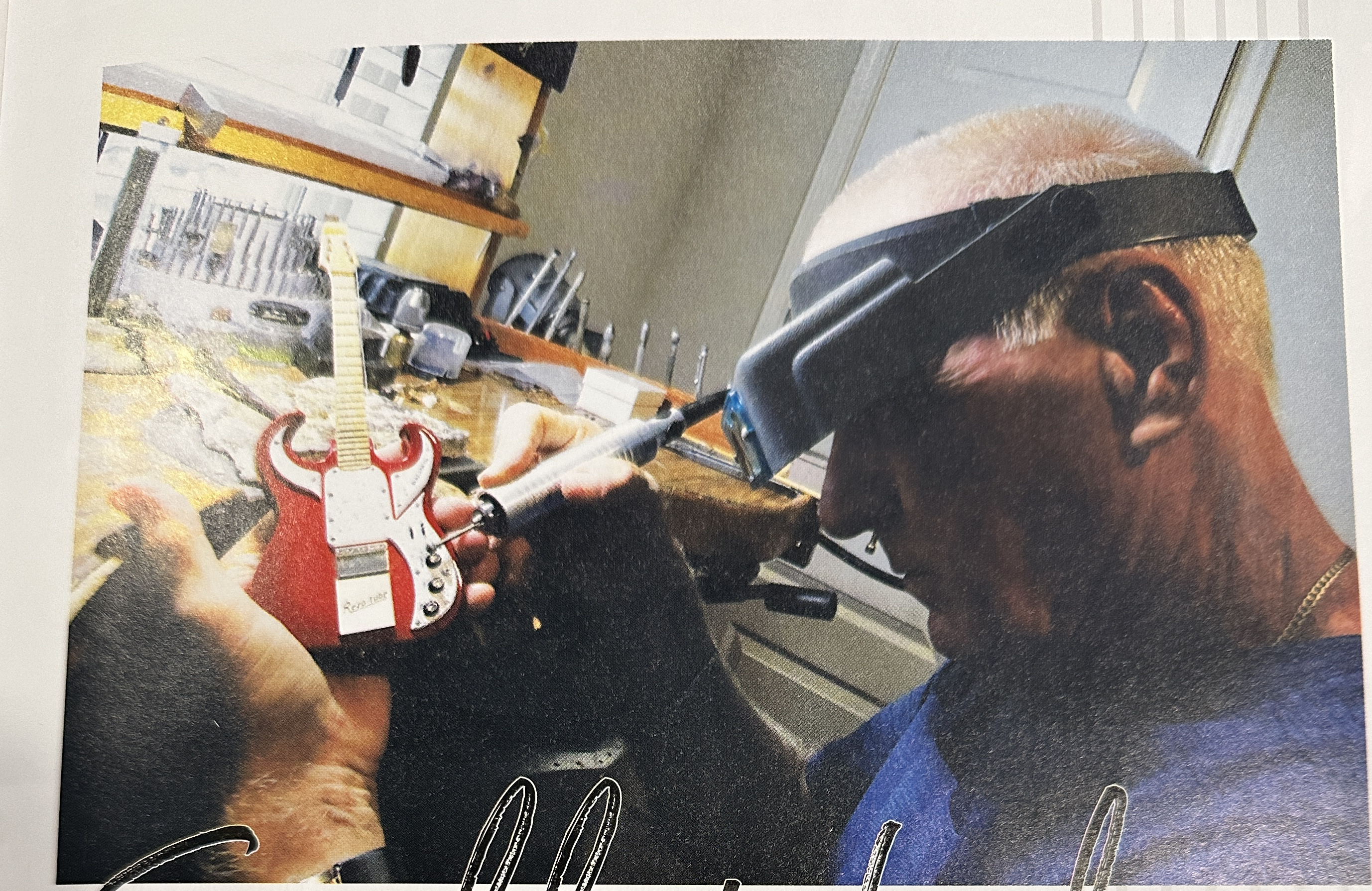
Rob begins with a full-size reference and paper template, then shapes the body and neck, fabricates the hardware, assembles the parts, and finishes the details by hand. He does not use casting or molding, and a typical miniature guitar takes approximately 6 to 7 days of hands-on work.
Start with proportion
How are miniature guitars made? Rob Gwynn begins with a full-size reference and a paper template, then shapes the body and neck, fabricates the hardware, assembles the parts, and finishes the details by hand. He does not use casting or molding. A typical guitar takes approximately 6 to 7 days of hands-on work.
Shape the body from real wood
The process starts with proportion. A miniature guitar is not successful simply because it is small. Its silhouette, neck, bridge, control layout, and hardware must work together so the finished piece is recognizable as the guitar that inspired it. Rob's pieces are approximately 8.75 inches long, a consistent size that makes them easy to display and compare as a collection.
Rob uses printed reference images and paper templates to transfer the important lines of a guitar to the selected wood. Depending on the design, that may include maple, zebra wood, mahogany, Texas mesquite, rosewood, or another suitable hardwood. The template is a starting point, not a shortcut. The shape still has to be cut, filed, and refined by hand.
The body is where the character of the piece begins to emerge. Rob follows the curves, edges, contours, and cutaways with small files and hand tools. Grain matters. A figured maple body will speak differently from a dark mahogany body or a piece of Texas mesquite. Finish, color, and the way the grain catches the light all become part of the final design.
Fabricate the hardware
The neck and headstock require the same discipline. The neck has to be proportionate to the body, and the headstock needs enough room for the tiny tuning posts and strings. Rob attaches the neck in a way that follows the construction logic of a real guitar, rather than treating it as a flat decorative line.
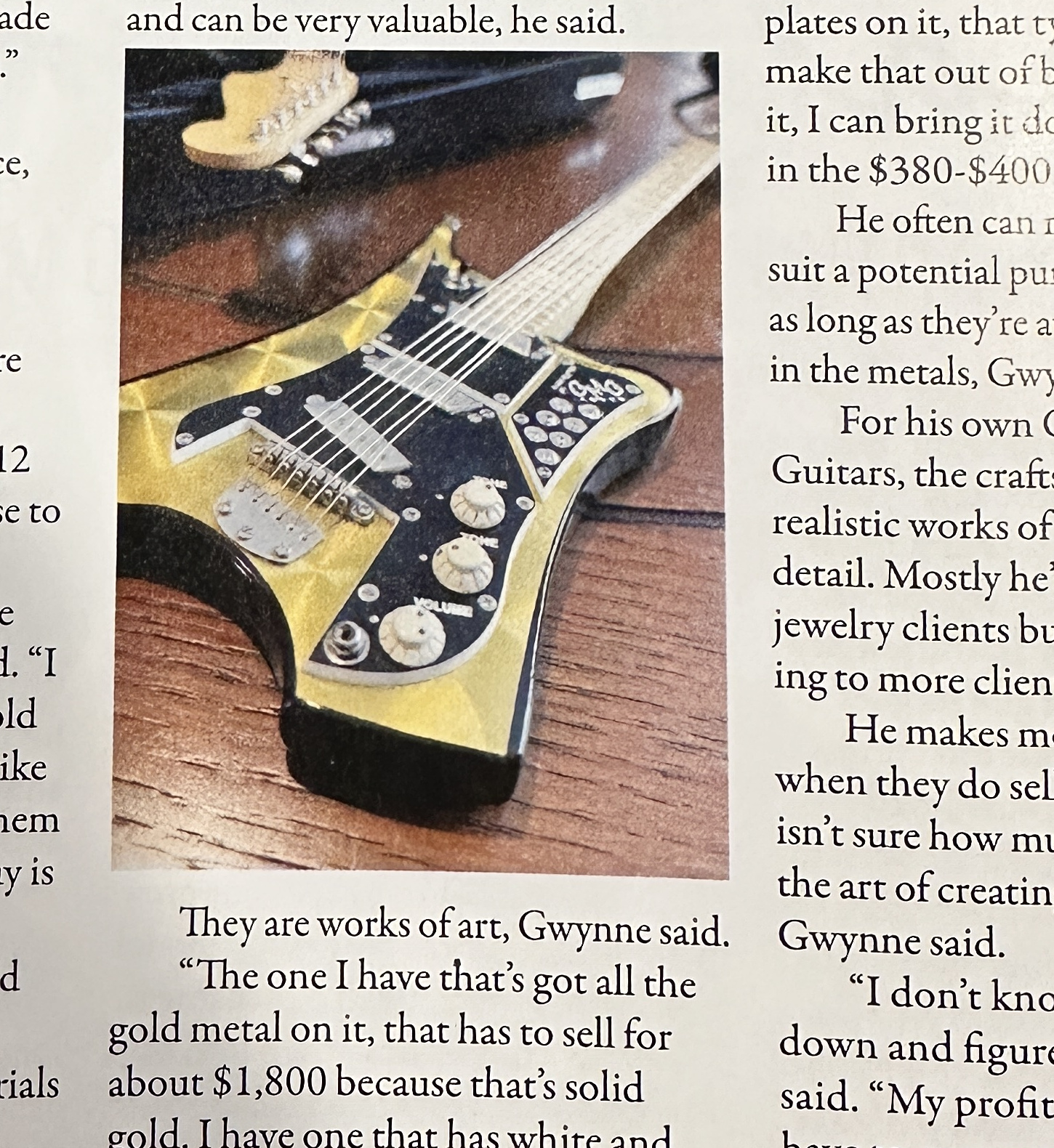
Next comes the hardware. Rob hand-fashions components such as the bridge, saddle, tuning posts, knobs, pickup covers, and switch plate. Brass, sterling silver, and genuine gold are separate material choices. A silver-colored finish is not sterling silver, and a gold-colored accent is not solid gold. The material list for each piece tells the collector what is actually there.
Build the smallest details
The smallest details often take the longest attention. Frets are placed individually. Pickguards are cut from selected materials. Tiny screws and fittings are made or adapted to suit the scale. Some pieces include gemstones, shell, or engraved plates. A detail that would disappear on a full-size instrument can become a focal point on a miniature.
Strings are installed one at a time. Rob uses fine plastic-covered wire, approximately 0.38mm, to create the six-string appearance. They are part of the visual realism, but the finished guitar remains a static display object. It is not built to be played or tuned like a full-size instrument.
Assemble and inspect
Assembly brings the separate decisions together. Rob uses jeweler's adhesives where appropriate, checks the alignment of the neck and hardware, and refines the finish until the piece reads as one coherent object. The inspection is both practical and visual: Does the guitar sit correctly? Do the details line up? Does the chosen material combination support the design?
Why the maker matters
This is also where a goldsmith's experience changes the result. Working at miniature scale requires control, but it also requires judgment. Rob knows when an edge needs another pass, when a piece of metal is too heavy for the design, and when a small detail will make the finished guitar feel convincing.
The result is a handmade miniature guitar with a process behind it that can be traced. There is a wood choice, a set of fabricated components, a sequence of small decisions, and several days of focused work. No casting or molding replaces those steps.
To see the finished results, browse the collection. To request a particular model or discuss materials, visit the custom replicas page and send Rob an inquiry.
People Also Asked
Q: What are handmade miniature guitars made of?
Materials vary by piece and may include exotic hardwoods, brass, sterling silver, genuine gold, wire, shell, and gemstones.
Q: Does Rob use molds to make the guitars?
No. Rob hand-fabricates the miniature guitars without casting or molding.
Q: How long does one miniature guitar take to make?
A typical piece takes approximately 6 to 7 days of hands-on work, with delivery generally planned for 4 to 6 weeks.